
ARTICLE · Construction
The meeting cascade: why construction misses deadlines away from the site
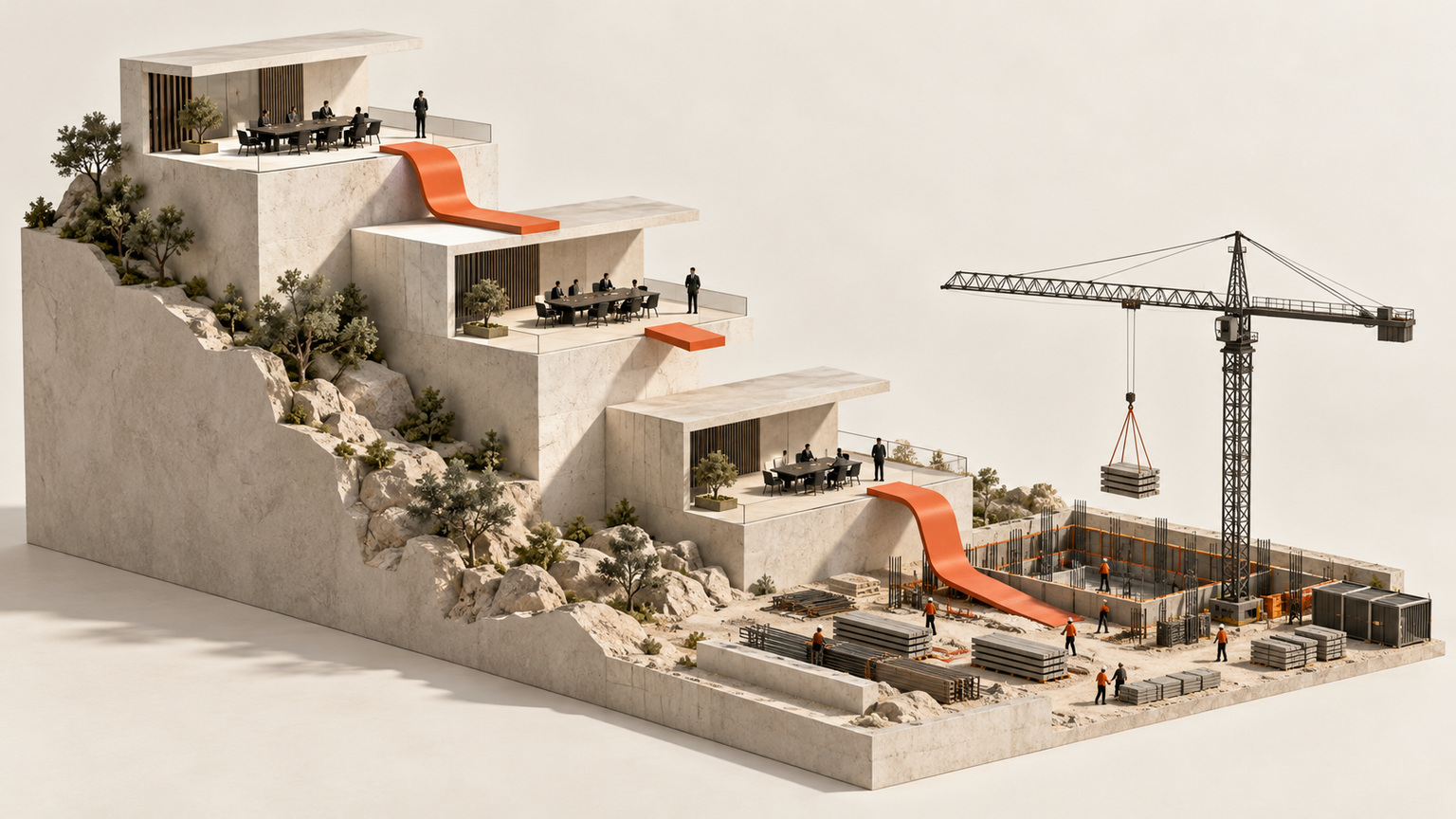
A diagnostic of the meeting system on two industrial construction projects: what actually eats an EPC contractor's schedule — and how it gets fixed in three months
When an industrial construction project falls behind schedule, the first explanation is always the same: not enough people, machinery, materials. This spring and summer we ran diagnostics on two large industrial projects in Russia's northern regions — and saw a picture that does not fit that explanation. People were on site. Machinery, apart from isolated episodes, was there. Materials across the core list were 99% covered. Yet monthly plan completion ranged from 13 to 50%.
The gap between "the resources are there" and "the plan is not being met" does not live on the site. It lives in the meeting rooms — in how the project's meeting system is built. The industry calls it a cascade: a linked chain of meetings from the foreman's daily stand-up to the monthly review with the division director. In our experience it is the cascade — not the excavators and not the crews — that determines whether resources turn into pace.
What the meeting cascade is, and why it is not a "meeting calendar"
The cascade rests on the logic of the Last Planner System: the plan sets the schedule, and the meeting system brings work to readiness in advance. Five planning levels — from the master schedule through pull planning and a 4–6 week look-ahead to daily assignments and a weekly reliability review (PPC, the share of promises kept exactly on time) — work as filters: only work that is fully enabled, with a front, materials, machinery and decisions in place, should reach the crew.
The cascade is not the number of meetings. Both of our projects had enough meetings, in places even too many: daily status calls with the client, evening planning sessions, weekly and monthly reviews with management. Formally the cascade existed. The real question is always different: what do these meetings actually control.
The case: two projects, one diagnosis
We worked to a single method: 25+ interviews with managers at every level, live meeting assessments against a 28-criteria checklist, around a thousand field measurements (crew time studies, engineering staff presence at work fronts), and a six-month retrospective of plan-versus-actual, minutes and delivery registers. Everything below is not participants' opinions but measured fact.
Project A is a large build in its active phase, with peak volumes ahead. Project B is a reconstruction, more than 80% complete, on the home straight. Different stages, different teams, different management cultures — and a strikingly similar diagnosis.
Finding one: meetings record status instead of managing the deadline
Meeting effectiveness against the checklist ranged from 23 to 61%, with mature systems targeting 80–85%. But the structure of the failure is more interesting than the average. The "preparation" and "discussion productivity" blocks scored high: people come prepared and talk substance. The same two blocks failed everywhere: metrics and the recording of decisions.
At one project's evening planning session the "plan-versus-actual and KPI" block scored zero out of sixteen: only tomorrow's plan was discussed; the day's actuals were never reviewed. Not one observed format had a written agenda. In the internal loops of both projects not a single set of minutes was kept: decisions lived in notebooks, messengers and participants' memory. A verbatim quote from our checklists: "deadlines agreed loosely — in two or three days, by the middle of next week."
My conviction after these weeks: a meeting without minutes is not a meeting but a conversation. It can be substantive, tough, useful — but its result evaporates the moment the participants walk out.
Finding two: problems do not travel upward
Over the observation period we logged 39 problems in the register on one project — from delayed deliveries to idle contractor machinery. The fate of those problems is an X-ray of the cascade: 15% solved locally, 10% escalated upward, 75% stuck. One problem in ten gets escalated. Worse: the problems that directly blocked the lagging work stalled more often than the rest — they are "known to everyone," and precisely for that reason nobody sees the point of raising them formally.
On the second project the same mechanism looked different: the same questions returned for three or four meetings in a row with no change of status. An instruction was worded, passed on verbally, the deadline named "loosely," and a week later the meeting opened with finding out what had happened. Nothing had.
The right rule here has long been known: a problem not solved within 24–48 hours at its own level automatically rises one level up — not as a complaint, but as a register line with an owner and a date. Tellingly, the head of one of the projects formulated this rule himself at a meeting in front of us. What was missing was not understanding — it was a mechanism in which escalation happens on the fact of a missed deadline, not on participants' memory.
Finding three: data you cannot trust destroys even a strong system
The most unexpected observation concerns motivation. One of the projects ran a genuinely tough regime: deviation from schedule hit managers' income directly, up to and including personnel decisions. A client's dream, you would think. But with weak verification of actuals the construction backfired: volumes began to close "on paper," actuals were bent to fit the plan, and the official remaining scope drifted from reality by roughly a third. The system started motivating people to report rather than to finish.
To my mind this is the case's main lesson for any industry, not just construction: motivation is stronger than data. Tie money to a number nobody verifies and you will get a beautiful number — and lose the picture of reality on which all plans are built. Before tightening KPIs, build verification of actuals; on a construction site that means volumes confirmed by technical supervision — a mechanism that already existed on this very project for daily work orders and only needed to be extended.
"Arguments about the numbers" belong to the same category: at Project A's meetings the same piece of work was estimated by participants at figures that differed by multiples, because each had their own source of data. A meeting that starts with establishing what to believe never gets to decisions.
Finding four: the best practices are already on site
A diagnostic is not only a search for gaps. On both projects we found practices I would not hesitate to put into any EPC contractor's corporate standard: a month-and-day schedule that lives and is updated monthly down to the day; daily work orders with workers' signatures and confirmed volumes; an evening planning rhythm after which the morning shift starts without a warm-up; one team's daily field loop — issuing assignments, walk-downs to a set routine, recording actuals with photographs.
This is an important point for owners: you almost never need to bring a management system in "from outside." On a mature site 70–80% of the required elements already exist — scattered, running on individuals' enthusiasm, without a standard. The consultant's job is not revolution but completion: connect the working elements, add the missing loops and remove the system's dependence on personalities. A system that works only under a specific director is not a system — it is his personal achievement.
What we proposed: completion in three months
The change plan on both projects came down to four moves. First, an unconditional rhythm: key meetings always happen, with a stand-in rule for the chair; cancellation only by the leader's conscious decision. Second, a single "task — owner — deadline — status" protocol at every level and one instruction register with automatic escalation of anything overdue. Third, a look-ahead enablement loop: a dedicated slot where materials, money and technical decisions are worked 4–6 weeks out — before they stop the front. Fourth, a trustworthy baseline: one remaining-scope figure, confirmed by commission, and a planning reliability metric (PPC) at the weekly review.
None of these moves requires investment, hiring or software. It is a standard and the discipline of the first four weeks. The quick wins are measurable: recovering just half of the forced losses of working time that we measured in the time studies is equivalent to adding 20–25% of the site's working hours — without a single new person.
What this means for the industry
Construction in Russia is entering a period when adding resources will keep getting more expensive: a shortage of people, costly money, sanctions-era logistics. In these conditions manageability — the ability to turn the resources you have into pace — becomes an EPC contractor's main competitive advantage. And that advantage lies not in CAPEX but in the meeting room: in the agenda, the minutes, the instruction register and the 24-hour rule.
The meeting cascade is the cheapest lever of operational efficiency I have seen in industry. It needs no machinery, no people, no software — only the first person's decision to make the system mandatory. The paradox is that this is exactly why it so rarely gets fixed: buying ten dump trucks looks more decisive than introducing minutes. But the dump trucks will stand in the same queues while the meeting that was supposed to clear that queue ends with the words "well, let's say by the middle of next week."
Need a diagnostic of the management system on your project?
Get in touch →